Shenzhen, September 8, 2026 – Credo Technology Group Holding Ltd (Credo) (NASDAQ: CRDO), an innovator in providing connectivity at scale through fast, reliable, and energy-efficient system solutions, held a special media event in Shenzhen in conjunction with the China International Optoelectronic Expo (CIOE). Credo executives discussed the real-world challenges of scaling high-speed AI networks and the interconnect technologies that are helping customers meet the growing demands for bandwidth, power efficiency, and network reliability. The Company briefed the media on its system-level strategy, showcasing optical DSPs, Silicon Photonics, ZeroFlap Active Electrical Cables (AECs) and OmniConnect Weaver memory fanout gearbox solutions.
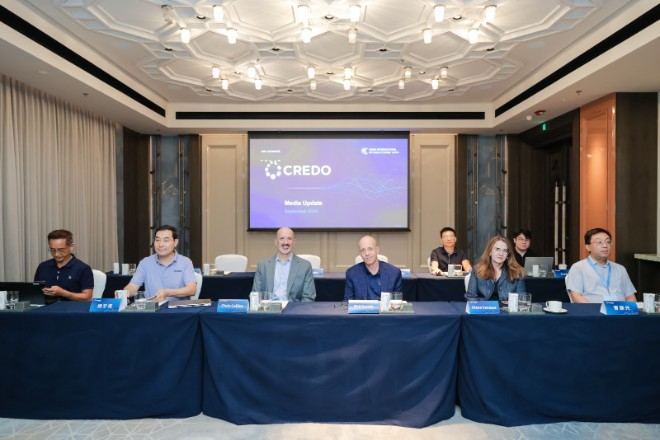
Credo Leadership Introduces 2.0 System-Level Strategy for AI Networks
As AI models and workloads continue to grow in scale, industry focus has expanded beyond individual GPU performance to the networks that connect large AI clusters. As deployments evolve from tens to hundreds and thousands of GPUs, the ability to efficiently move data across the cluster has become increasingly important. As a result, high-performance interconnect technologies that deliver low latency, high reliability, and scalable deployment have become critical to enabling the next generation of AI infrastructure.
Simon Yang, Credo China Region Sales Vice President, stated at the event that this industry transformation has also driven Credo to evolve from a chip vendor to a provider of system-level interconnect solutions — what Credo calls the 2.0 strategy.
Credo announced its first quarter of fiscal year 2027 financial results on September 1. The company serves more than 24 tier-1 flagship customers, has maintained rapid growth for multiple consecutive quarters, and continues to gain market share. The company's global workforce is rapidly approaching 1,000 employees, with the Greater China region a strategic and critical component of its global footprint and AI ecosystem. Employees in China and Chinese Taiwan account for approximately half of the company's total headcount, with teams established in Shanghai, Wuhan, Nanjing, and Hong Kong, building a complete localized R&D, sales, and technical support ecosystem.
Over the past 12 months, Credo completed two strategic acquisitions: acquiring Hyperlume to expand Micro-LED next-generation light source technology, and acquiring Israeli silicon photonics company DustPhotonics to bolster silicon photonics-based PIC (photonic integrated circuit) capabilities. Through in-house development plus these acquisitions, Credo has built out full-stack capabilities spanning SerDes IP, DSP chips, Silicon Photonics chips, active electrical cables (AECs), ZeroFlap optical transceivers, and PILOT link monitoring software — achieving true vertical integration, and becoming one of the few vendors in the industry capable of covering the entire interconnect chain in AI data centers.
Chris Collins, who leads Credo’s Optical DSP product line, provided a detailed overview of the company's complete optical DSP product portfolio. Credo has iterated through seven generations of DSPs, covering 50G/lane, 100G/lane, and 200G/lane speeds. Addressing the industry-wide challenge of supply constraints, Credo's Robin 800 series leverages architecture optimization with established process technology to deliver power and performance comparable to the previous-generation Lark products. The DSP includes EML laser drivers, with a reduced package size, while supporting both Full DSP and LRO (Linear Receive Optical) architectures, helping mitigate upstream supply constraints while providing customers with greater confidence in long-term supply continuity.

Chris Collins, Associate VP of Credo Optical Marketing, DSP Product Portfolio
For the 1.6T era, Credo has introduced the Cardinal series of optical DSPs. Differentiating from the industry's common 8-channel single-die approach, the Cardinal family offers two die options: 4-channel and 8-channel. The Cardinal 802 (4×200G) serves both 800G and 1.6T scenarios; for the LRO route, Credo has launched the Cardinal 852 (4-channel transmit) and Cardinal 1650 (8-channel transmit), addressing both 800G and 1.6T LRO markets to provide customers with greater design flexibility. Credo is actively advancing its next-generation 448G/lane DSP technology to address future high-speed interconnect requirements.
Leveraging Dust Photonics' technology heritage, Credo presents a complete portfolio of silicon photonics products, including silicon photonic engines with integrated light sources and standard PIC chips without integrated light sources. Its in-house developed L3C low-loss laser coupling technology represents a core differentiator, compatible with mainstream commercial lasers on the market, illuminating multiple channels with fewer lasers to reduce overall module power consumption and BOM costs. This technology also supports future evolution paths for NPO (Near Package Optics) and CPO (Co-Packaged Optics), enabling development of high-channel-count PICs (16-channel, 32-channel, etc.), and supports mass production and immersion cooling applications.
"DSP and silicon photonics are not simply two chips stacked together — the synergistic co-optimization of the two is where the core value lies," said Chris Collins. Credo achieves joint tuning and testing of its optical DSP, silicon photonics PIC, and firmware, with device interfaces characterized upfront to reduce cross-vendor integration cycles and shorten time-to-market. When new challenges arise and new applications are needed, customers need only engage a single Credo team to troubleshoot; meanwhile, both technology roadmaps remain synchronously iterated, evolving from 100G/lane and 200G/lane to future 400G/lane, continuously delivering complete solutions to customers.
At the event, Credo also highlighted its ZeroFlap product family, which includes ZeroFlap AECs (Active Electrical Cables) and ZeroFlap optical transceivers. Leveraging dedicated IP embedded in the DSP and PILOT telemetry software, the ZeroFlap solution enables real-time monitoring of both optical and electrical links, enabling proactive prediction of link degradation risks; even in the event of sudden link failures, the system can fully record pre-failure link states to help operations personnel pinpoint root causes, significantly improving AI cluster interconnect reliability — making it ideally suited for Scale-Up (vertical expansion) AI cluster scenarios.
Addressing the "memory wall" challenge widely encountered in AI inference, Credo showcased its OmniConnect architecture and Weaver chip solution. This solution leverages external LPDDR memory to achieve bandwidth approaching HBM while delivering multiple times the memory capacity of HBM, providing a completely new memory expansion path for AI inference scenarios.
Regarding the LPO (Linear Drive Pluggable Optics) technology route that has generated significant industry discussion, Credo already possesses a complete LPO DSP and silicon photonics product portfolio, and is fully prepared should the market embrace large-scale deployment. However, it must also be objectively acknowledged that as per-lane speeds continue to increase, the removal of DSP results in the loss of capabilities such as signal equalization, component impairment compensation, and long-channel compensation — meaning LPO will face significant technical challenges in many link scenarios. Customers need to rationally evaluate technology choices, such as LRO where a DSP is in the transmit path, based on their specific application scenarios.
During the media Q&A session, Credo executives engaged in in-depth discussions with media on hot-topic issues including supply chain assurance, packaging and testing bottlenecks, competitor differentiation, sales organization structure, China market strategy, and AI market growth prospects. Credo executives noted that despite market discussions about an AI bubble, frontline customer feedback indicates that many tier-1 cloud providers have already signed long-term business agreements, locking in compute, land, and power resources. Credo is optimistic about AI interconnect industry growth opportunities over the coming years and is actively expanding production capacity and team to match long-term market growth demands.
The China market occupies a strategically vital position in Credo's global business footprint. A significant share of Credo's optical DSP business revenue comes from domestic partners; accompanied by the rapid rise of domestic GPU vendors, the OmniConnect memory interconnect solution also represents significant market opportunity in China.
This media briefing has concluded successfully. For any further product inquiries, technical exchanges, or interview requests from industry partners and media, please contact Credo's Marketing and Business Development team directly.
About Credo
Credo’s mission is to transform connectivity at scale through fast, reliable, and energy-efficient system solutions. Our high-speed copper and optical interconnect technologies deliver industry-leading power and performance from chip to cluster to meet the ever-expanding data infrastructure demands of AI.
Our vertically integrated connectivity portfolio is comprised of our flagship purple ZeroFlap (ZF) Active Electrical Cables (AECs) and ZF optical transceivers; optical components including silicon photonics-based photonic integrated circuits (SiPho PICs) and DSPs; OmniConnect AI memory and chip-to-chip interconnect; and retimers for Ethernet and PCIe—supported by our PILOT diagnostic and analytics software platform. Credo innovations enable our customers to connect the systems that connect the world.