Oct 30, 2026 | CFOL News When it comes to Malaysia’s homegrown optical communications firms, PCOM Technologies stands out. Several years ago, I first met Mr. Guven Togan, President of PCOM, when I was invited to address the FTTH Council on China’s FTTR rollout progress. In today’s AI-dominated landscape, how are companies like PCOM — once focused entirely on telecom fiber networks — navigating transformation? This afternoon, CFOL editors paid an on-site visit to PCOM Technologies in Kuala Lumpur, Malaysia’s leading optical communications engineering provider, for an in-depth discussion with Mr. Guven Togan, also Vice-Chair of the Fiber Network Council APAC (FNCA).
About PCOM: From Industry Pioneer to Infrastructure Builder
Founded in Kuala Lumpur in 1999, PCOM has built up more than two decades of expertise in optical communications and digital infrastructure. Its portfolio covers fiber cable network deployment, intelligent building infrastructure, smart city development and end-to-end Fiber-to-the-Home (FTTH) delivery.
During the boom of Malaysia’s national telecom broadband buildout, PCOM played a key role in the High-Speed Broadband (HSBB) national program. It designed and set up the first passive optical network (PON) lab for Telekom Malaysia, and also served as an official training institute, upskilling thousands of local FTTH field engineers.
Malaysia’s total FTTH footprint now stands at roughly 4 million subscribers, and PCOM alone has delivered nearly half of these connections. It is widely recognised as Malaysia’s top fiber engineering contractor.
Transformation in the AI Era
As optical communications players face the historic shift from legacy national telecom access networks to high-density interconnections for AI data centres, how should the industry seize this opportunity? Drawing on PCOM’s real-world experience and his insights from the regional industry council, Mr. Guven shared his perspectives.
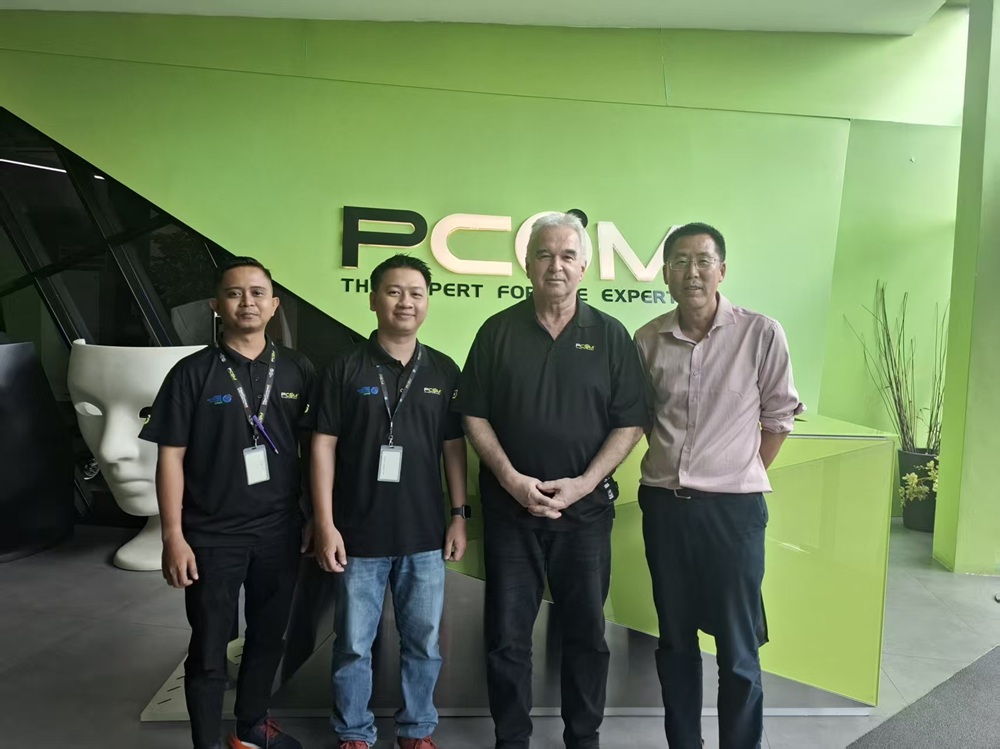
(Photo: Editor (far right) together with Mr. Guven Togan (second from right) and his team)
1. Limits of Traditional Manufacturing: Reassessing Scale and Capacity
Asked whether PCOM plans to move upstream into in-house production of optical components and fiber cables, Mr. Guven offered a pragmatic assessment. He confirmed that PCOM did explore captive manufacturing back in the FTTH boom years, when order volumes were abundant.
Yet manufacturing follows a fundamentally different set of rules compared with engineering services. Without sustained, massive volume to unlock scale economies, in-house production lines struggle to remain competitive on cost, supply chain resilience and equipment refresh cycles.
This trial helped PCOM sharpen its positioning and define the boundaries of its core strengths. Heavy-asset manufacturing expansion is not the right strategy for every engineering firm. The company’s competitive moat lies in solution integration and turnkey delivery.
2. Tapping the Compute Wave: From 96-Core Telecom Links to 576-Core Ultra-High-Density DC Interconnects
With telecom operator access network construction maturing, the data centre (DC) market has become an urgent new frontier for optical communications vendors. Mr. Guven noted that PCOM has secured a substantial pipeline of DC cabling and interconnection projects through deep partnerships with leading international and local data centre general contractors.
He highlighted the substantial technical leap separating DC work from conventional telecom deployments:Dramatically higher fiber density: Standard FTTH telecom networks typically deploy 96-fiber cables. By contrast, intra-data-centre links and Data Centre Interconnect (DCI) applications demand unprecedented space and bandwidth density, with 576-fiber and higher-count ultra-high-density fiber cables now commonplace. LC connectors remain the dominant interface type across incoming orders.
“Malaysia’s data centre buildout is still accelerating faster than many other Southeast Asian markets,” Mr. Guven added. “That creates high-value opportunities for firms with proven fiber deployment track records.”
3. Corporate Transformation: Shifting from Product Sales to Solution Delivery
“The era of simply selling standalone products is over. The market now demands complete end-to-end solutions,” Mr. Guven stated firmly.
As Malaysia’s premier fiber engineering provider, PCOM’s core advantage in this transition is its robust integrated delivery ecosystem:
Established global procurement channels to reliably source premium components;
In-house processing and pre-termination capabilities for customised, site-specific data centre requirements;
Local high-tier construction certifications, a skilled workforce and a track record of complex project handovers.
This closed-loop capability — procurement, prefabrication, certified construction and on-site execution — is scarce and highly prized by international data centre developers entering the Malaysian market.
He also offered a view of competitive dynamics: “Downstream engineering and installation services are increasingly subject to winner-takes-all consolidation in the data centre sector. Small and mid-sized contractors are rapidly losing market space.” Market share will concentrate among leading providers with valid certifications, large-scale delivery capacity and stable supply chain access.
The Power of Networking: Ecosystem Collaboration and Advice for Chinese Vendors
In his capacity as Vice-Chair of FNCA, Mr. Guven also outlined how companies can leverage industry associations to build collaborative ecosystems. He stressed that councils such as FNCA do not directly hand out client leads or purchase orders. Instead, they serve as an irreplaceable platform for high-level industry networking.
Through FNCA, PCOM maintains direct, stable ties with top-tier supply chain partners worldwide, including fiber giants YOFC and Corning, high-density interconnect leaders SENKO and Sunwa, and structured cabling heavyweight CommScope. In the fast-evolving compute era, these ecosystem connections form the resource pool that allows firms to rapidly assemble high-performance solutions and respond to urgent build requirements.
He described the recently concluded FNCA 2026 Annual Conference in Kuala Lumpur as a great success, drawing over 250 global delegates and more than 20 exhibitors.
For Chinese optical communications companies targeting Southeast Asian expansion, his advice is clear:“Chinese suppliers must recognise that the old model of competing purely on low-cost hardware sales no longer works. Overseas data centre buyers and local partners prioritise full solution delivery capability, regulatory compliance and ecosystem integration. Only by evolving from product vendors into turnkey solution and service providers can Chinese firms establish a lasting foothold and thrive amid the AI compute boom.”
Closing Thoughts
From laying the groundwork for 4 million FTTH residential connections to deploying 576-fiber ultra-dense cabling for AI compute facilities; from pure fiber installation to full-spectrum solution delivery, PCOM’s journey mirrors the development of Malaysia’s optical communications sector. Its transformation offers valuable lessons for optical players globally navigating structural change brought by artificial intelligence.